


Recycled plastic dunnage for precast tunnel segments
Dunnage supports stored components at defined locations. In tunnel segment production, “dunnage”, “spacers” and “stacking blocks” describe supports used between successive layers of concrete segments.
Discuss your project →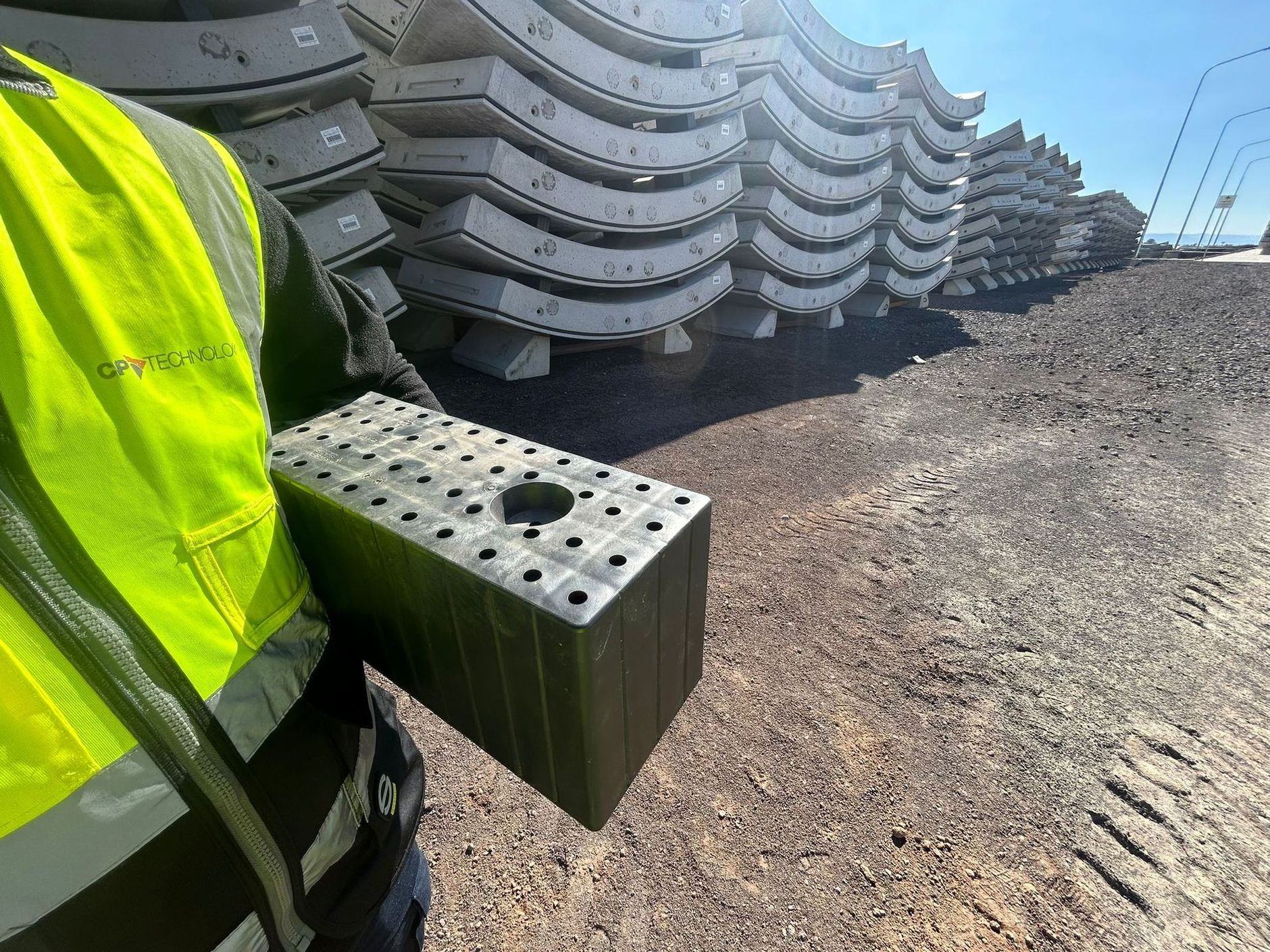
Start with the bearing arrangement
Green Spacers are recycled plastic dunnage developed for precast tunnel segment storage in factory yards and TBM site storage areas. The spacer footprint, height and orientation must work with the segment’s planned bearing areas.
A suitable arrangement considers the complete stack: base supports, spacers between layers and alignment of the specified bearing points.
Segment geometry
Define the bearing footprint, required separation height and support positions.
Working load
Assess the load on each spacer and actual sharing between supports.
Service conditions
Consider operating temperature, loading duration, handling and inspection.
Understand the working load
The Working Load Limit, or WLL, is the stated maximum recommended working load for one spacer under its specified operating and installation conditions.
Per spacer. Under specified conditions.
WLL is not the allowable weight of an entire stack. Selection requires an assessment of how loads reach each support, together with the applicable product data.
| Standard size · H × W × L | Declared WLL per spacer |
|---|---|
| 170 × 150 × 500 mm | 30 t |
| 150 × 150 × 600 mm | 40 t |
Follow model-specific conditions. Actual load sharing and custom layouts require assessment.
Include temperature and loading duration
The operating environment is part of product selection. Consider the temperatures the spacer may experience and how long it will remain under load. A nominal load value must be considered alongside its applicable temperature conditions.
Choose dimensions for your application
Standard configurations are available. Project-specific dimensions and identification requirements can also be discussed. Start with segment drawings, the required separation height, bearing footprint and expected load on each spacer.
Plan for inspection and reuse
Where spacers are intended for repeated use, inspection and acceptance criteria form part of the operating procedure. Continued use depends on the spacer’s condition and the requirements of the approved application.