


Alternatives to timber spacers for precast tunnel segments
Timber spacers, wooden blocks and wooden dunnage separate successive layers of precast concrete tunnel segments. Green Spacers offer an alternative manufactured from 100% recycled plastic, weighing approximately 4 kg per spacer for easier lifting and positioning.
Discuss your project →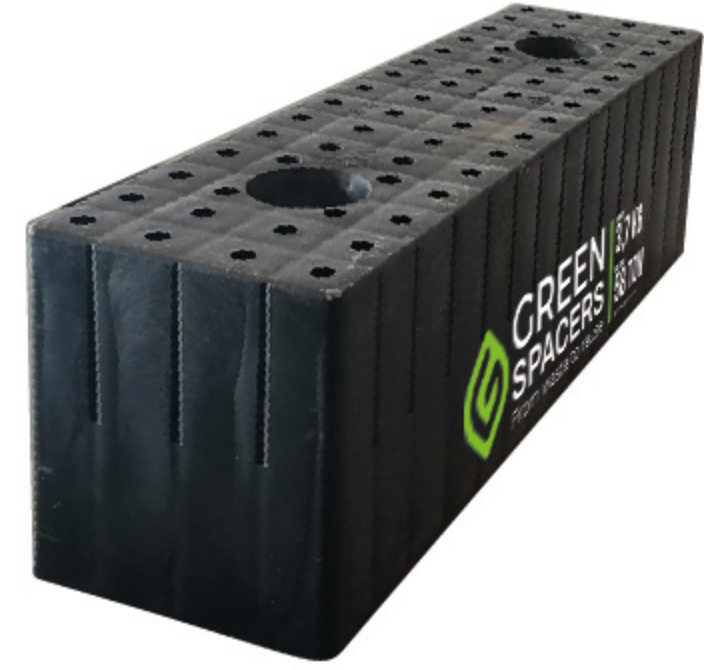
What should a timber replacement do?
A spacer forms part of the storage system. Its dimensions and bearing surfaces must suit the intended contact areas, while its working load must be appropriate for the loads and conditions it will experience.
Selection starts with the segment and storage layout, rather than simply copying the external dimensions of an existing timber block.
Geometry & load
Segment weight, support locations, stored layers and actual load distribution.
Operating conditions
Bearing alignment, temperature, loading duration and approved handling movements.
Inspection & reuse
Condition checks, acceptance criteria and intended service life.
Timber supports and Green Spacers
Lighter spacers. Less strain on operators.
At approximately 4 kg, Green Spacers are easier to lift, carry and position than a 20 kg timber support. Less weight to lift helps reduce physical strain on operators’ backs during repeated placement.
Less weight at every placement.
Heavier to lift and reposition.
About 80% less weight to lift in this comparison.
A 20 kg timber support may require two operators, depending on the task and site procedures. Green Spacers reduce the weight handled; lifting methods and crew requirements follow the site’s manual-handling assessment.
Illustrative comparison: approx. 4 kg versus a 20 kg timber support. Actual timber weight varies with dimensions, wood and moisture.
| What matters | Traditional timber supports | Green Spacers |
|---|---|---|
| Weight to lift | Approx. 20 kg in this timber example. Actual weight varies with size, wood and moisture. | Approx. 4 kg per spacer: about 80% less weight in this comparison. |
| Manual handling | A 20 kg support may require two-person handling, depending on the task and site procedures. | Less weight to lift, carry and position, helping reduce physical strain during repeated handling. |
| Material | Timber properties depend on the selected wood and its condition. | 100% recycled plastic. |
| Positioning | Supports positioned according to the specified bearing layout. | Locating pins engage matching sockets to help repeat the planned position. |
| Environmental approach | Sourcing, service life and replacement requirements. | Recycled plastic as an alternative to new wooden supports. |
A defined positioning system
Green Spacers combine a recycled plastic body with locating pins that engage matching sockets cast into the concrete. The body supports the vertical load; the pins help operators repeat the planned position and help restrain lateral sliding during approved handling.
Compare cost over the application
Purchase price is one part of the comparison. Also consider handling, inspection, replacement frequency and the number of acceptable uses. Compare the cost of providing the required support throughout the application, using realistic assumptions for both timber and plastic spacers.
Recycled material with a practical purpose
Replacing wooden supports with recycled plastic spacers gives recycled material a role in infrastructure production. A wider environmental comparison should consider sourcing, transport, service life, reuse and end-of-life arrangements.